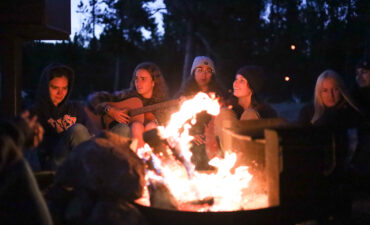
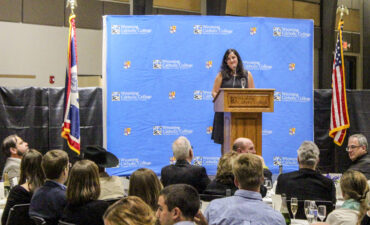
In the view of Wyoming Catholic College, a post-secondary education should teach the whole person in his three dimensions of mind, body, and spirit. Moreover, it should provide the student with sound reasoning and communication skills, strong virtues, and a broad understanding of the rich heritage of Western Civilization. All the while, the education should foster the student's natural sense of wonderment at the world and things newly learned, for it is when the wonderment is lost that the student's right relationship with creation and with others falters. We also believe that this vision can be realized only with reference to Catholic faith and practice, which formed Western civilization and culture for nearly two millenia.
We invite you to download a printable PDF file of our complete Philosophical Vision Statement. For a brief summary of our philosophical vision, please see below.
A Summary of WCC's Philosophical Vision Statement
By Robert K. Carlson Professor and Academic Dean Wyoming Catholic College
Our Mission
Wyoming Catholic College is a four-year college committed to offering a liberal arts education that steeps its students in the awesome beauty of our created, natural world and imbues them with the best that has been thought and said in Western civilization, including the moral and intellectual heritage of the Catholic Church. The College strives to promote a love of learning, an understanding of natural order, and the quest for virtuous living so that its graduates will assume their responsibilities as citizens in a free society.
Its curriculum and campus are devoted to the formation of the whole person, i.e., the spiritual, physical and intellectual dimensions. Studies include the classics of imaginative literature, history, mathematics, science, philosophy, fine arts, and theology. They employ the Great and Good Books as well as the natural created world, effecting a rich combination of intellectual and experiential-poetic knowledge. Students' imaginations are enriched and their capacity for wonder deepened. Moreover, students and faculty share in a campus life that reflects the ideals taught directly and indirectly in the classroom.
In the Catholic tradition, emphasis is placed not on the dissemination of information, but rather on the development and perfection of the intellect, the passions, and the will, enabling students to approach and embrace the good, the true, and the beautiful throughout their lives.
In addressing the whole person the College contributes to the students' spiritual and moral formation. This is done via Catholic culture, context, and traditions. The College is staunchly faithful to the Magisterium of the Roman Catholic Church and the deposit of faith handed down over the past two thousand years.
The Philosophical Foundation of Wyoming Catholic College
Catholic tradition holds that there are two means to acquire sure knowledge of the truth, by reason and by divine faith, the first leading to natural truth and the second to supernatural truth, which are the proper goals of liberal education. In respect to reason, Western education is traditionally based on the philosophia perennis or perennial philosophy, which, Jaques Maritain claimed, "existed from the dawn of humanity in germ [and] has remained firm and progressive…while all other philosophies have been born and have died in turn." John Paul II calls the perennial philosophy an "implicit philosophy…within the history of thought as a whole, based upon man's common experience of reality and his common-sense judgments about that reality."
According to the perennial philosophy, a reality external to the mind exists, the mind can know this reality, and a person can communicate that knowledge. Such principles (those, for example, of non-contradiction or finality and causality) belong to this philosophy, and although these principles have occasionally been attacked throughout the ages, the attacks have had no lasting success. Wyoming Catholic College thus recognizes the perennial philosophy as the bedrock of reason and education.
The College is firm likewise in its conviction that through divine faith, God has revealed certain truths that reason alone is incapable of knowing. These truths are contained in the Deposit of Faith that has come down to us through Sacred Scripture and Tradition, authentically interpreted, taught, and guarded by the Magisterium of the Holy Catholic Church.
The Occasion for the Founding of the College
The occasion for founding Wyoming Catholic College is the crisis of disintegration we are now facing in Western culture, especially in education. In 1982 President Reagan convened the National Commission on Excellence in Education. Its report begins, "Our nation is at risk…The educational foundations of our society are presently eroded by a rising tide of mediocrity that threatens our very future as a nation and a people." In newspapers, magazines, newscasts, and so forth it's obvious that schools are troubled and that a large number of academicians think truth is an obsolete term.
The modern world has accepted the old sophism proclaimed by the ancient Greek philosopher Protagoras, that "man is the measure of all things." Solzhenitsyn says this view could be called anthropocentricity, "with man seen as the center of all." And when man is the center of all, then each decides for himself what is true. Truth loses all objectivity and descends into pure subjectivism. We no longer seek truth; we create it. And what follows but anarchy and the disintegration of education and culture alike? Nearly everyone is aware of the signs of our failed elementary and secondary schools: a fragmented curriculum offers a potpourri of courses ordered to no apparent end; a high number of students drop out of school; schoolrooms are filled with undisciplined and apathetic students; students lack the basic educational skills of reading, writing, thinking, observing, calculating, and speaking; and teachers are expected to assume the roles of mother and father, brother and sister, friend and counselor—a burden unjustly visited upon them.
The crisis invades higher education as well. A college or university might now more accurately be termed a "pluraversity" or "multiversity." Robert Hutchins, past Chancellor of Chicago University, writes: "The modern university may be compared with an encyclopedia. The encyclopedia contains many truths. It may consist of nothing else. But its unity can be found only in its alphabetical arrangement. The university is much the same. It has departments from art to zoology, but neither the student nor the professors know what is the relation of one departmental truth to another."
Without unity of knowledge and without disciplines ordered to a general end, students find only specialization, especially specialization ordered to vocationalism. If a person becomes learned only in his specialty, he remains uncultured or illiberally educated.
Wyoming Catholic College provides a place where our youth have the opportunity to turn away from the sophism, subjectivism, and specialization of our age and turn towards the objective natural and supernatural truths of reason and faith.
The Nature of Liberal Education
The nature of a liberal education rests on a definition of education in general. The word is from the Latin ex-ducere, which means "to draw out" or "to educe," in our case that which is potentially but not yet actually in the student. Tradition has defined education as "the cooperative art of making men better." A philosophy of education must therefore address the question of what "a better man" is. In essence, he is one who perfects his innate potentialities and powers through good physical, moral and intellectual habits or virtues. Virtues are acquired throughout one's lifetime, through both formal and informal education; and formal education may be liberal or illiberal, the traditional distinction being that liberal education aims at making men better as men by perfecting their similar natures, while illiberal education aims at making men better as workers by perfecting their different, individual talents. Liberal education produces good men; illiberal education produces good workers. Thus liberal education, being general rather than specialized, is said to be everybody's rather than somebody's business.
John Stuart Mill argued that the undergraduate college should provide a liberal education only. "Universities," he said, "are not to make skillful lawyers, or physicians, or engineers, but capable and cultivated human beings." Further, "Men are men before they are lawyers, or physicians, or merchants…and if you make them capable and sensible men, they will make themselves capable and sensible lawyers or physicians."
The Immediate Purpose of Liberal Education
In philosophy, one speaks of immediate, proximate, and final purposes. We will address each of these. First, in relation to education, the immediate purpose is the development of physical, moral, and intellectual virtues, which are good habits. Physical virtue is said of a sound and graceful body and of well-formed powers of sense, both internal and external; moral virtue pertains to an ordered and harmonious soul; and intellectual virtue to the disciplined mind.
Physical virtue is acquired through the poetic modes of gymnastics and music. The poetic mode of education begins in the home, as children listen to stories read out loud to them, as they play, and as they sing. They develop their external senses as well as their internal ones (imagination, memory, etc.). As the educator Michael Platt pointed out, "Learning is first in the senses and in the imagination before it is in the intellect."
Gymnastics embraces athletic arts or skills but includes as well some more refined activities such as stargazing, horseback riding, and dancing; and music includes not only tune or the melding of tunes and words, but also the fine arts such as sculpture, architecture, pictorial art, and imaginative literature. Students at Wyoming Catholic College will not lose touch with physical virtue. The location of the College, close to the mountains and far from a man-made environment, keeps the student close to reality, and its curriculum and culture further his experience with music and fine arts, guiding him towards loving reality, mystery, and eventually wisdom.
A liberal education cultivates first the physical and then moral virtue, also essential to a well-educated, "better" man. As far back as Plato, tradition teaches that a moral, harmonious soul is characterized by the cardinal virtues of prudence, temperance, fortitude, and justice. If we were solitary creatures, prudence, temperance, and fortitude would suffice, but because we are social animals, members of families, cities, and states, we need the virtue of justice, which looks to the good of others, to the common good of the state, and ultimately to the individual's own good.
Because our college is Catholic, it is interested also in the theological virtues of faith, hope, and charity. Unlike the natural moral virtues, acquired by repetitive doing, the theological virtues are freely given by grace. Nonetheless, a college can help students be more apt to receive such grace.
The moral virtues are developed by practice and encouraged through education in three ways: by example, by poetic moral education, and by campus culture. The most efficacious way to make students want to practice virtue is by example. It is thus imperative that Wyoming Catholic College employ persons of good moral character—teachers, priests, administrators, and workers.
In addition to example, a poetic education inspires students morally. They read tales of heroes and discuss heroic, virtuous characters in poetry. Through a poetic moral education, the students become better apt and able to consider, judge, and understand moral precepts.
Lastly, a good cultural environment is conducive to moral development. Wyoming Catholic College will establish and cultivate a proper campus culture through the liturgy, sacraments, and music of the Roman Catholic Church integrated into the life of the College.
The intellect is the highest power of man because it is spiritual. It knows being in an immaterial way; it influences and orders all of man's lower powers; and it accounts for his special dignity as a species made in the image and likeness of God. The intellectual virtues are habits of knowledge that better the mind either by helping it acquire knowledge as an end in itself or by helping it acquire knowledge for the sake of practice. The first is speculative knowledge, which betters the mind by understanding, science, and wisdom, while the second is practical knowledge, which betters the mind through prudence and art.
The liberal arts will be of special concern at Wyoming Catholic College because they are the arts of learning itself. They govern the operations of thinking, reading, writing, speaking, observing, and calculating. The liberal arts, traditionally, are divided into the trivium and quadrivium. The trivium consists of grammar, logic and rhetoric, which discipline the mind as it finds expression in language. The quadrivium includes geometry, arithmetic, astronomy, and music. These four arts constitute the mathematical disciplines, as is obvious in respect to arithmetic and geometry but true also of astronomy and music, which may be considered from a purely quantitative point of view.
All intellectual disciplines of study may be approached from the point of view of general or liberal studies rather than just specialized or vocational studies. As Mortimer Adler has said, "Even the literature of the sciences and of mathematics can be read and understood in a way that brings them within the grasp of the generalist who, in the light of his common sense and his common experience, asks philosophical questions about them and uses the liberal arts to pursue the answers."
The Proximate Purpose of Liberal Education
The intellectual virtues are the ultimate focus of the physical and moral virtues that constitute the immediate purpose of education. Wyoming Catholic College does not limit its scope to the immediate purpose, however, but also considers the proximate and final purposes. A liberal education initiates and educates us into a culture. Thus acculturation is the second, proximate purpose of liberal education. Our greatest English poet says a person plays many parts in his lifetime—mother and father, teacher and student, vocationalist and avocationalist—but he always carries his humanity with him. He is always the human father, the human teacher and the human vocationalist. Wyoming Catholic College thus deals with the perennial questions that address God, man, and nature, such as what it means to be a civilized man or a barbarian, the purpose of work and leisure, the nature of democracy and tyranny, the value of wealth and luxury, the battles of man and nature, and the relation of man to God. To ignore these questions is to forget that, prior to being a parent or a worker, one is fundamentally a human person with all the questions the human condition gives rise to, all the fertile insights our culture has transmitted to us, and all the wisdom our holy faith brings to us.
The Final Purpose of Liberal Education
The third or final purpose of a liberal arts education is man's final goal: happiness. The highest good we seek is natural happiness in this life and in the supernatural happiness of the life to come. A Catholic liberal education produces a free man who, because he possesses the intellectual, moral, and theological virtues, can direct himself—with God's grace—to his proper end.
|